Legal & compliance in localization: What SaaS teams must know before going global

Translating your UI is the visible part of going global. The less visible part is everything your legal team should have reviewed before you launched in that market.
Privacy notices, terms of service, cookie consent dialogs, and accessibility requirements are all localization concerns, not just legal ones. If the translated strings in your app say one thing and your legal documents say another, or if your consent flows do not meet local requirements, you have a compliance problem.
This post covers the legal dimensions of localization that most SaaS teams discover too late, and how to build compliance into your workflow before it becomes a problem.
Why legal compliance is a localization problem
When you ship your product in a new market, you are making representations to users in that jurisdiction about what your product does, how their data is handled, what they are agreeing to, and what rights they have. Those representations are legally binding in many markets.
"We translated our English terms" is not a defense when the translated version does not meet local legal requirements. The four areas where this matters most for SaaS teams are:
-
Privacy notices.
Your privacy policy is a legal document. GDPR requires it to be written in a language users can understand, and it must meet specific content requirements that a standard US-style privacy policy typically does not include. -
Terms of service.
Consumer protection law varies significantly by country. Clauses that are standard in US SaaS agreements are unenforceable in Germany, France, and Brazil. Translating non-compliant terms does not make them compliant. -
Cookie consent.
GDPR and US state privacy laws use different consent mechanisms. A consent banner configured for one does not satisfy the other. -
Accessibility.
Several jurisdictions now require accessibility standards by law. Localized versions of your product must meet the same requirements as the original.
GDPR: The most common compliance gap
GDPR applies to any product that processes personal data of EU residents, regardless of where your company is headquartered.
From a localization standpoint, the key requirements are:
-
Privacy notices must be in the user's language.
GDPR Article 12 requires information provided to data subjects to use "clear and plain language". The EDPB has consistently interpreted this to mean the language of the user. If you are targeting German speakers, your privacy notice should be in German. -
The content requirements differ from a US privacy policy.
A GDPR-compliant privacy notice must include the legal basis for each type of processing, retention periods, a full description of data subject rights (access, rectification, erasure, restriction, portability, objection), and information about international transfers. Most US-style privacy policies do not include all of this. Translating an incomplete policy into German does not make it compliant. -
Consent language must be specific and unbundled.
When consent is the legal basis for processing, the consent request must describe exactly what the user is agreeing to. It cannot be bundled with terms acceptance. Pre-ticked boxes are not valid consent.
The practical implication: privacy notices should be treated as jurisdiction-specific documents, not a single source document with translations. Your EU privacy notice may need to differ substantively from your US one. That means legal review in each target market, not just translation review.
What a compliant GDPR localization workflow looks like
A SaaS company expanding to Germany might approach it like this:
- Legal drafts a GDPR-compliant privacy notice for the EU, rather than translating the existing one.
- A professional translator handles the German version, with legal review of the translated text.
- The German privacy notice lives at a distinct URL (
/de/privacy) and is linked from the German-language product. - When the privacy notice is updated, the German version is updated in parallel, not weeks later.
That last point matters operationally. Legal documents cannot lag behind their source versions while the product continues to operate. Your localization workflow needs to treat legal document updates as high priority, with defined turnaround times.
Cookie consent: EU vs US
Cookie consent is the most visible compliance localization element. It is also one of the most frequently configured incorrectly across markets.
-
EU / EEA (GDPR + ePrivacy)
Non-essential cookies require prior, informed consent before they are set. The consent UI must describe cookie categories, allow granular opt-in, avoid patterns that make rejection harder than acceptance, and allow users to change their preferences later. The consent notice must be in the user's language. -
United States
Requirements come from state laws, not a federal standard. California's CPRA requires a "Do Not Sell or Share My Personal Information" opt-out link and honoring Global Privacy Control signals. It does not require an opt-in consent banner in the GDPR sense. Virginia, Colorado, and several other states have similar opt-out frameworks.
The mechanisms are fundamentally different: EU requires opt-in before setting non-essential cookies; US generally requires opt-out after. A single consent banner configured for GDPR will not satisfy US requirements, and a US-style opt-out mechanism does not meet GDPR.
Terms of service: What breaks by market
Standard US SaaS agreements contain clauses that are unenforceable or prohibited in several major markets.
-
Germany
German civil code provisions on standard business terms (AGB) prohibit clauses that unreasonably disadvantage consumers. Courts have voided limitation of liability clauses, automatic renewal terms without adequate notice, and warranty disclaimers that exceed what German law permits. Your German terms need local legal review, not just translation. -
France
The Loi Toubon requires that any document addressed to the public in France be in French. Terms, privacy notices, and key UI elements must be in French. The French version is legally authoritative for French consumers. -
Brazil
Brazil's Consumer Defense Code (CDC) requires that contracts and disclosures be clear and not misleading. LGPD adds specific requirements for consent language and data subject rights. Brazilian Portuguese terms need to reflect both frameworks.
A note on governing law clauses.
Standard US SaaS agreements specify US state law as the governing law. EU consumer protection directives give consumers the right to the protection of their home country's mandatory laws, regardless of what the contract says. Your governing law clause may not override mandatory local consumer rights.
Accessibility requirements by law
Accessibility is increasingly a legal requirement, not a voluntary best practice.
-
European Accessibility Act (EAA)
The EAA requires WCAG 2.1 Level AA compliance for in-scope digital products including e-commerce, banking services, and electronic communications, with compliance required from June 2025. -
Section 508 (US)
Applies to federal agencies and organizations receiving federal funding. For SaaS products sold to US government customers, Section 508 compliance is a procurement requirement.
The localization implication.
Localized versions of your product must meet the same accessibility standards as the original. A German translation that strips alt text, reduces color contrast, or breaks ARIA labels is not a compliant German product. Accessibility review needs to be part of your translation QA process for every locale.
Building compliance into your localization workflow
Here are best practices for integrating legal compliance into your localization workflow:
-
Separate legal documents from UI strings.
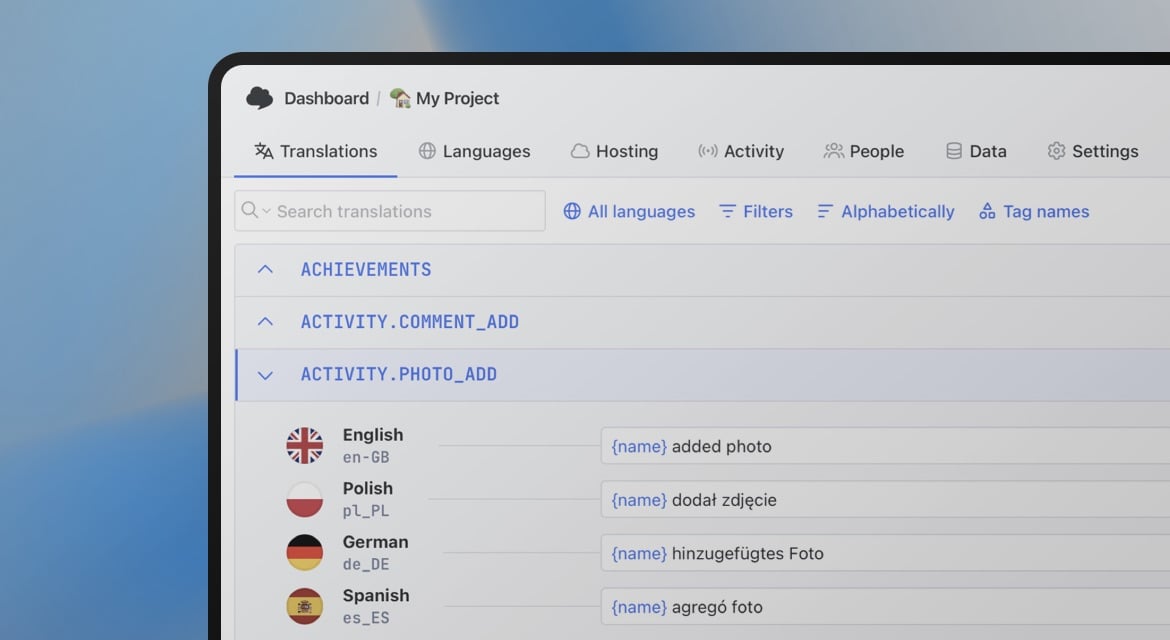
Your translation management system should distinguish between UI content and legal content. Legal content requires different reviewers, different approvers, and different update processes. In SimpleLocalize, namespaces or tags let you separate legal content and route it through a specific review workflow. -
Define update SLAs for legal documents.
When your legal team updates the English privacy policy, how long can the German version remain out of date? For most regulated products, the answer should be measured in days. Build this into your workflow with notifications when source legal documents change. -
Use professional translators for legal content.
AI and machine translation are appropriate for UI strings. Legal documents are different. A mistranslation in a privacy notice or terms of service can have material legal consequences. Professional translators with legal subject matter expertise, followed by local legal review, is the right process for these documents. -
Test consent flows in each locale.
Verify that the correct consent logic fires, that the correct legal document versions are linked, and that opt-out mechanisms work as described. This QA step is commonly missing from localization testing plans. -
Get legal review in each target market.
A US lawyer reviewing your German terms may catch some issues. A German lawyer who specializes in consumer contract law will catch more. Budget for local legal counsel in each significant market.
SimpleLocalize's text editor supports markdown formatting, which is ideal for legal documents. You can maintain the formatting of your privacy notices and terms of service across languages, ensuring that important sections and clauses are clearly presented to users in their native language.
Common mistakes
Be aware of these common issues that lead to compliance issues in localization:
-
Translating English legal documents directly. A translated US privacy policy is not a GDPR-compliant EU privacy policy. These are different documents with different content requirements.
-
Treating compliance as a launch-time task. Regulations change. New US state laws pass regularly. The EU AI Act introduces new requirements for AI-powered products. Compliance requires ongoing monitoring and updates.
-
No update process for localized legal documents. When the English privacy policy changes, what triggers the German update? If the answer is "someone remembers," you will fall behind. Define the trigger, the responsible person, and the turnaround time.
-
Skipping accessibility review for translated content. Translated strings can break accessible name patterns, ARIA labels, and error message associations. Accessibility review should happen on every localized version, not just the source.
Where to start
If you are expanding into a new market, do these four things before translation starts:
- Identify the applicable legal framework: privacy law, consumer contract law, mandatory language requirements, accessibility standards.
- Have a lawyer in the target jurisdiction review your existing documents against local requirements, to understand what needs to change substantively, not just linguistically.
- Separate legal translation from UI translation in your workflow, with different approvers and SLAs.
- Define how updates propagate: when source legal documents change, what triggers localized version updates.
For the broader strategic context around market selection, ROI, and localization workflows, see the localization strategy guide.