Localization maturity model: 5 stages of scalable global growth for SaaS

Expanding into new markets is easy. Scaling them profitably is not.
Many SaaS companies begin by translating a few strings and calling it localization. But as traffic grows and product complexity increases, cracks appear: inconsistent terminology, delayed releases, broken UI in secondary languages, poor conversions.
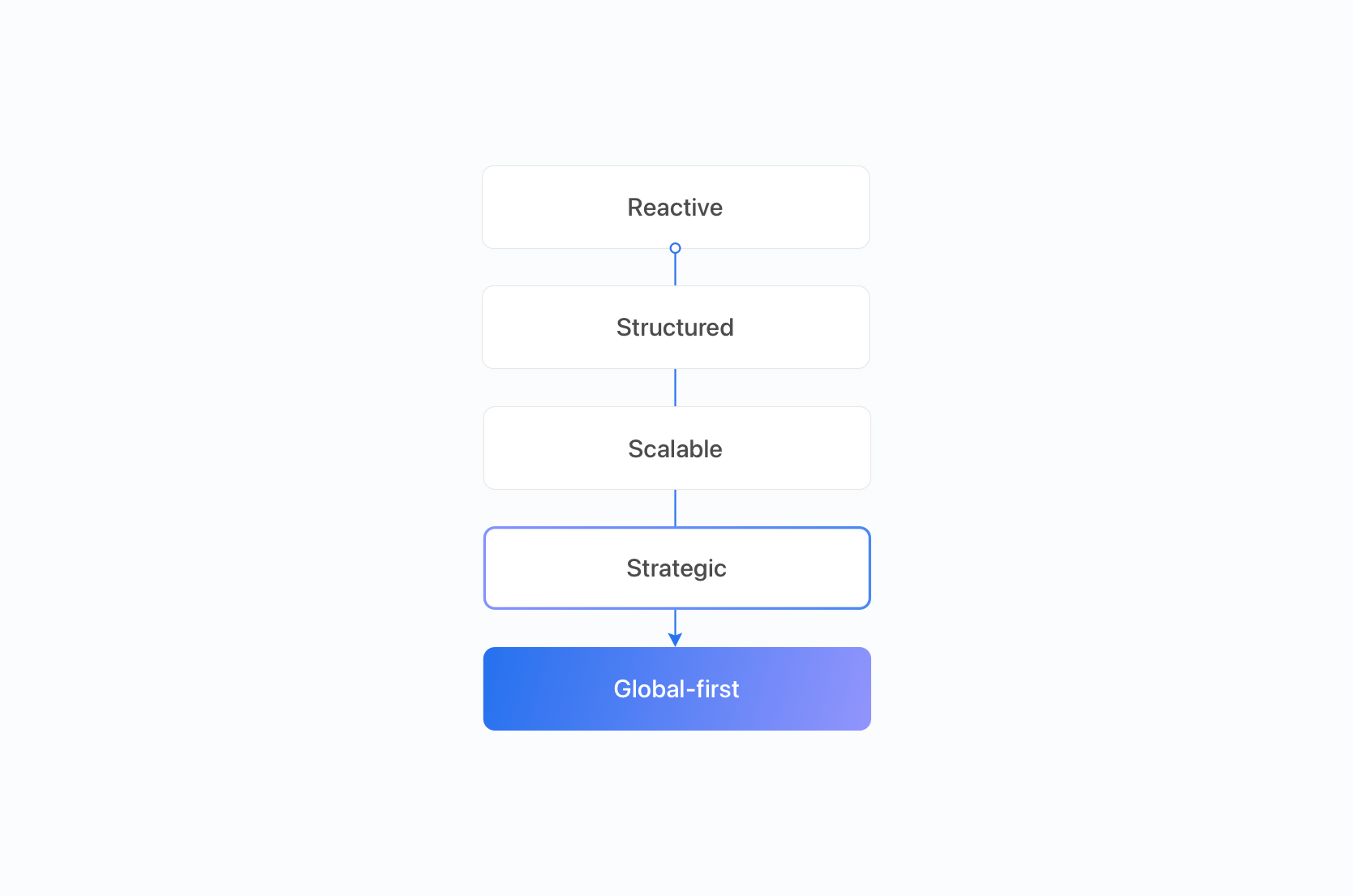
In this guide, we break down the 5-stage Localization Maturity Model, and show how:
- Workflows evolve
- Budget shifts from cost center to revenue lever
- Tooling becomes infrastructure
- QA matures from reactive to governance
- And whether automatic translation alone is enough
This article is part of our broader localization strategy framework (see the complete localization strategy guide).
What is a localization maturity model?
A localization maturity model measures how structured, scalable, and strategically aligned your localization efforts are.
It reflects how deeply localization is integrated into:
- Product development
- Engineering workflows
- Marketing expansion
- Revenue strategy
- Quality assurance
It's not about the number of languages you support.
It's about whether localization accelerates growth, or slows it down.

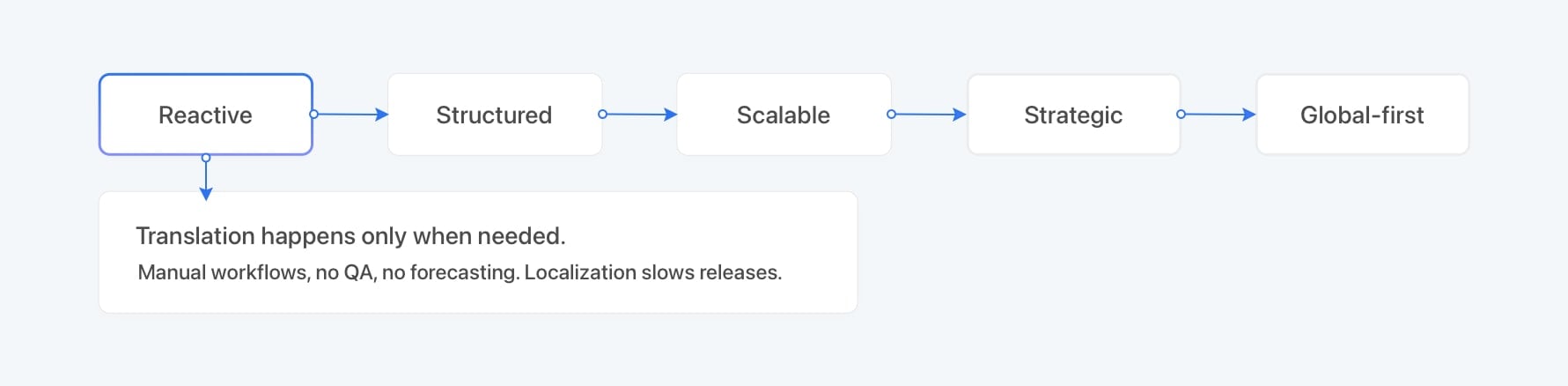
Stage 1: Reactive translation
"We'll translate when needed."
Common for early startups entering their first non-English market.
Workflow
- Manual export (CSV, spreadsheets)
- Freelancers hired ad hoc
- No alignment with sprint cycles
- Releases delayed waiting for translations
Budget
- Minimal
- No forecasting
- Translation treated as one-time expense
Tooling
- Spreadsheets
- No Translation Management System (TMS)
QA
- None
- Errors discovered by users
- No glossary or terminology consistency
At this stage, localization is reactive.
Scaling beyond 2-3 languages quickly becomes chaotic.
Stage 2: Structured localization
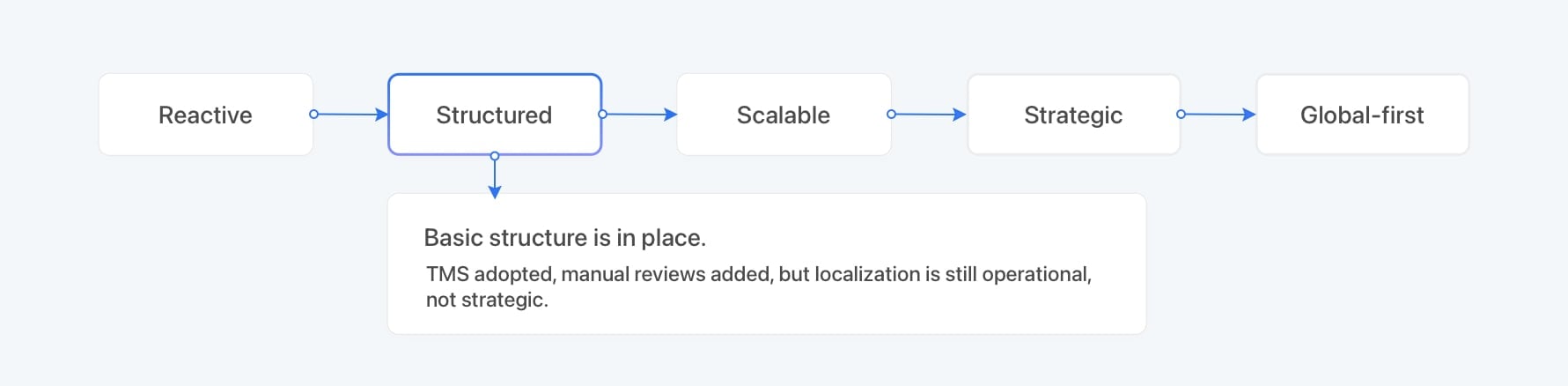
"We need structure."
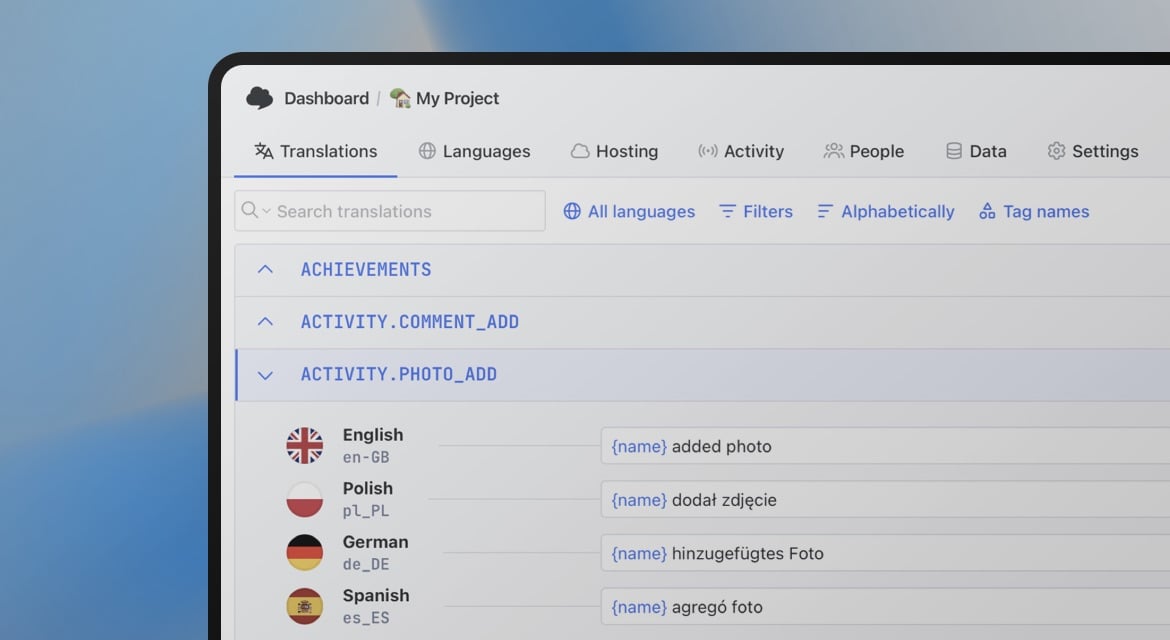
The company adopts a translation management system such as SimpleLocalize, Crowdin or Lokalise.
Workflow
- Strings synced automatically
- Basic role assignments
- Partial coordination with releases
Budget
- Annual or quarterly allocation
- Still seen primarily as operational cost
Tooling
- TMS implemented
- Basic Git or CMS integration
- Translation Memory starts accumulating
QA
- Manual review
- Inconsistent enforcement
- Limited automation
Localization is more organized, but still not fully embedded in product strategy.
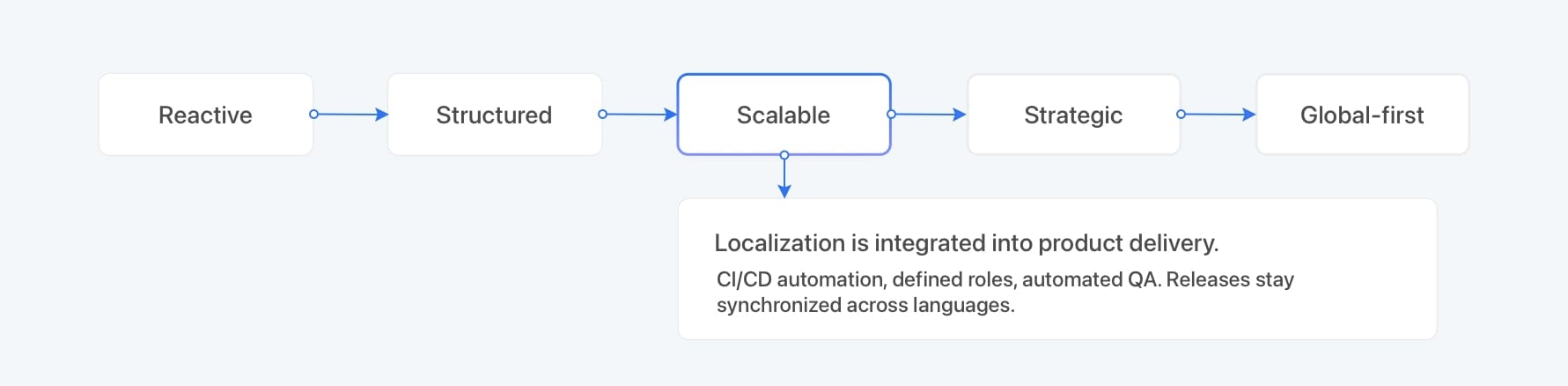
Stage 3: Scalable localization
"Localization is part of product delivery."
This is where continuous localization begins.
(If you're unfamiliar with this approach, see our guide on continuous localization.)
Workflow
- CI/CD integration
- Automated string extraction
- Defined roles (translator, reviewer, localization manager)
- Clear SLAs
Budget
- Predictable
- Vendor optimization
- Early ROI discussions
Tooling
- Advanced TMS usage
- Glossary enforcement
- Workflow automation
- Developer-first integrations
QA
- Automated checks (placeholders, length limits, variables)
- Mandatory review layer
- In-context preview before release
Releases across languages now happen simultaneously or within hours.
Localization now supports velocity instead of blocking it.
Stage 4: Strategic localization
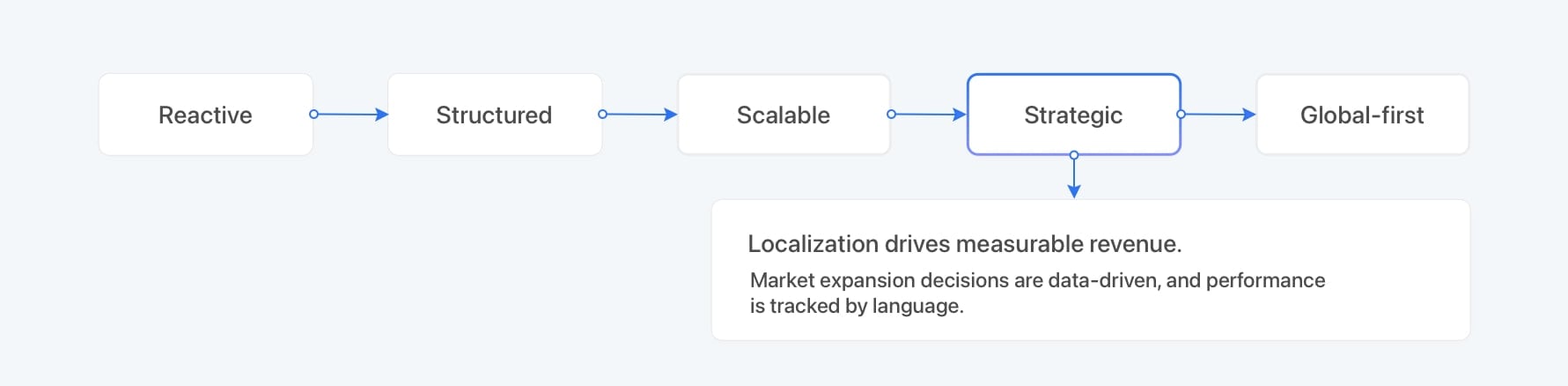
"Localization drives revenue."
At this level, localization decisions are directly tied to growth metrics.
Workflow
- Market selection based on demand signals
- Marketing + product alignment
- Localized landing page testing
- Dedicated localization ownership
Budget
- Allocated per market
- CPA and conversion measured by locale
- Expansion based on performance data
Tooling
- API-driven infrastructure
- Analytics integration
- Terminology governance across teams
QA
- Native linguistic review
- Cultural adaptation
- UX validation per locale
Companies here don't just translate UI.
They localize onboarding, pricing, emails, support flows, and acquisition funnels.
Stage 5: Global-first localization
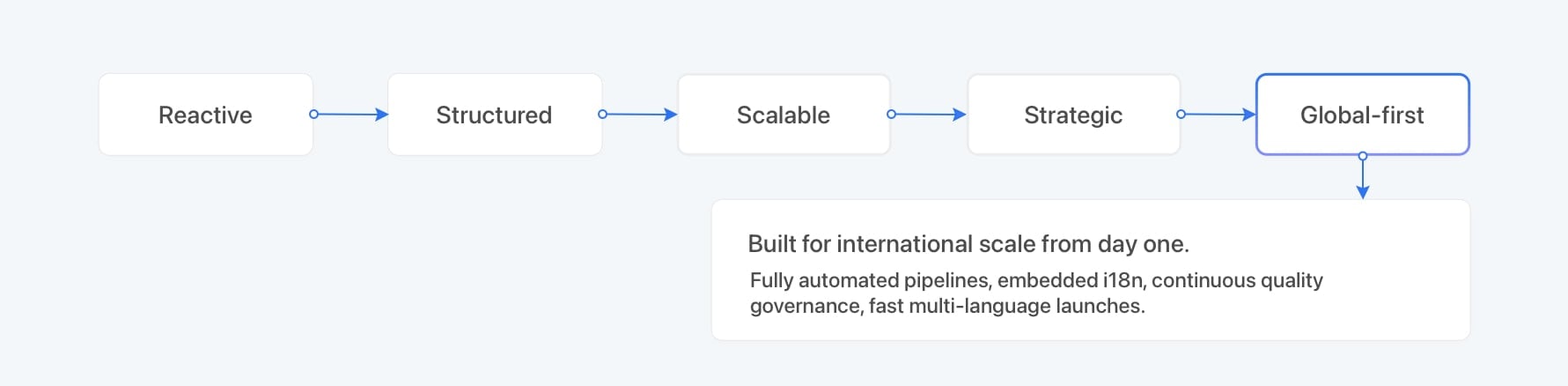
"We build globally from day one."
Few companies reach this stage, but it's the benchmark.
Workflow
- Internationalization embedded in architecture
- Pseudolocalization testing in development
- Simultaneous multi-language releases
- Localization sprint planning
Budget
- Treated as revenue multiplier
- International expansion integrated into product roadmap
Tooling
- Fully automated translation pipelines
- Centralized terminology governance
- Real-time localization sync
QA
- Hybrid AI + human validation
- In-market user testing
- Continuous quality scoring
New languages can launch in weeks, not quarters.
Workflow differences across stages
| Stage | Workflow type | Release impact |
|---|---|---|
| 1 | Manual | Delays & bottlenecks |
| 2 | Managed | Structured but slower |
| 3 | Continuous | Fast & synchronized |
| 4 | Growth-optimized | Revenue-aligned |
| 5 | Global-first | Scalable by design |
The biggest operational shift typically happens between Stage 2 and Stage 3.
Budget evolution
Early stages focus on cost per word and minimizing expenses.
Mature organizations measure:
- Revenue per locale
- CAC by language
- Retention by region
- Expansion ROI
Tool pricing structure plays a major role here.
If your TMS cost increases with every added language or API call, scaling becomes financially volatile. We explain this in detail in our guide on why many SaaS teams overpay for their TMS.
Localization maturity shifts the mindset from cost control → growth investment.
QA maturity differences
QA is often clearest signal of localization maturity.
| Stage | QA level |
|---|---|
| 1 | None |
| 2 | Manual review |
| 3 | Automated + human |
| 4 | Cultural & UX validation |
| 5 | Continuous quality governance |
Companies stuck at Stage 2 often believe tooling alone equals maturity.
It doesn't.
QA discipline is what separates operational localization from strategic localization.
Is automatic translation enough for SaaS products?
AI translation has improved dramatically. Many founders ask:
"If machine translation is this good, do we still need review?"
Short answer: Not if you care about conversion, trust, and compliance.
Some SaaS companies in early international phases rely heavily on automatic translation without structured QA. While this reduces short-term cost, it introduces risks:
- Incorrect financial or legal terminology
- Broken placeholders in UI
- Tone mismatch in onboarding
- Lower conversion in paid funnels
Machine translation is powerful, especially when combined with translation memory and glossary enforcement.
But maturity comes from combining:
- AI for speed
- Human review for nuance
- Automated QA for technical accuracy
Automatic translation alone typically keeps companies at Stage 2.
Hybrid systems define Stage 3 and beyond.
How to define your current stage
Ask yourself:
- Do releases get delayed due to translation?
- Are QA checks automated?
- Do you measure revenue by language?
- Is localization included in roadmap planning?
- Can you launch a new language in under 4 weeks?
Your answers reveal your maturity level.
If you are planning expansion, see our guide on localization strategy for global SaaS growth for market prioritization frameworks.
Moving up the maturity model
The most impactful transition is from Stage 2 to Stage 3.
To move forward:
- Integrate localization into CI/CD
- Automate QA checks
- Build terminology governance
- Measure revenue impact per locale
- Ensure pricing structure supports scaling
Localization maturity is not achieved by adding more languages.
It's achieved by building a system that scales without chaos, protects quality, and drives growth.
Conclusion
Localization maturity is not about language count.
It's about whether your system:
- Scales predictably
- Protects quality
- Enables fast releases
- Drives measurable international revenue
Early-stage companies translate.
Mature companies localize strategically.
Global-first companies design for the world from day one.
If localization is slowing your releases or creating financial uncertainty, you're likely between Stage 2 and Stage 3 — exactly where the biggest growth leverage exists.
If you're building a long-term global roadmap, start with the complete localization strategy guide and align tooling, workflows, and expansion decisions from the beginning.